The United States will be hosting the FIFA World Cup this summer for the first time since 1994. Much has changed in the soccer landscape both locally, nationally, and internationally.
In less than three decades, the national’s leading soccer organization has gone from a small office in the home of Horsham, Pennsylvania’s Werner Fricker to a national training center outside of Atlanta, Georgia funded by one of the country’s leading philanthropic sports owners.
We’ve come from a disbanded professional men’s league that at times, felt more like a mix between a rock concert and a retirement community to a stable national league with soccer-specific stadiums and its own TV network. The women’s game evolved from part-time pros to a thriving league, attracting top players from around the world, with a national team that has become a leader in women’s sports, often outselling the men in stadiums throughout the country. I could go on and on.
But the vision of future success in the game has its flaws. The U.S. Soccer landscape is by no means the train wreck often portrayed after the men’s team failed to qualify for the 2018 World Cup, or when the women failed to win the 2023 World Cup, however, in a country full of diverse opinions and philosophies on how to grow the game, we are still in some ways a house divided.
Matt Crocker hopes to change that.
“I was with the Union yesterday, and I walk in the first thing I see is the Irish Football Association, and they’re delivering something in a room upstairs,” Crocker told a crowded room of coaches at the United Soccer Coaches Convention in Philadelphia last week. “Breaks my heart because I think it should be us. Should be U.S. Soccer. We should be the port of call. But right now we aren’t, and we need to build that trust within the system.”
Crocker, U.S. Soccer’s Sporting Director, primarily focuses on the senior and youth national teams, overseeing player development and growth. He accepted the role in April 2023, during a time in which the U.S. began to face tremendous pressure as future hosts of the men’s world cup with a strong core of young players who still couldn’t get over the hump of occasionally good but never good enough. On the women’s side, the period of dominance from the USWNT had been tested across multiple levels as the competing organizations began to develop and fund women’s development programs across the club and national levels.
Prior to the U.S. Soccer appointment, Crocker served as the Head of Development Teams for the English Football Association and is partly responsible for England’s resurgence in recent years across both men’s and women’s international competitions. Crocker also led Southampton’s Academy, which produced players such as Gareth Bale, Alex Oxlade-Chamberlain, Luke Shaw, and James Ward-Prowse.
One of Crocker’s goals last year was to try to quantify where U.S. Soccer needed to be in order to compete in major tournaments on a consistent basis.
“We asked how many players in the men’s game, in the women’s game, in the top 250, in the top 1,000 do we need to have to basically be in a position where we can consistently challenge the latter stages of all major tournaments like World Cups?
“What they showed us was the men’s game and women’s game are totally different situations.”
The research company U.S. soccer hired analyzed world player rankings and winning percentages, and the results are staggering, although not surprising for many who keep up with the game.
In the women’s game, the research suggests that teams with a 50% or greater win percentage have averaged 7 or more players in the top 50 from 2015-2025. The U.S. averages 80 players in the top 250, what Crocker computes is enough to field four quality teams that could almost guarantee a quarterfinal position in every major tournament. Then, the team analyzed winning percentage with the top 1,000 players in the world and found that having 20 players in the top 1,000 tends to result in winning more than 45% of a country’s games. The U.S. has 180.
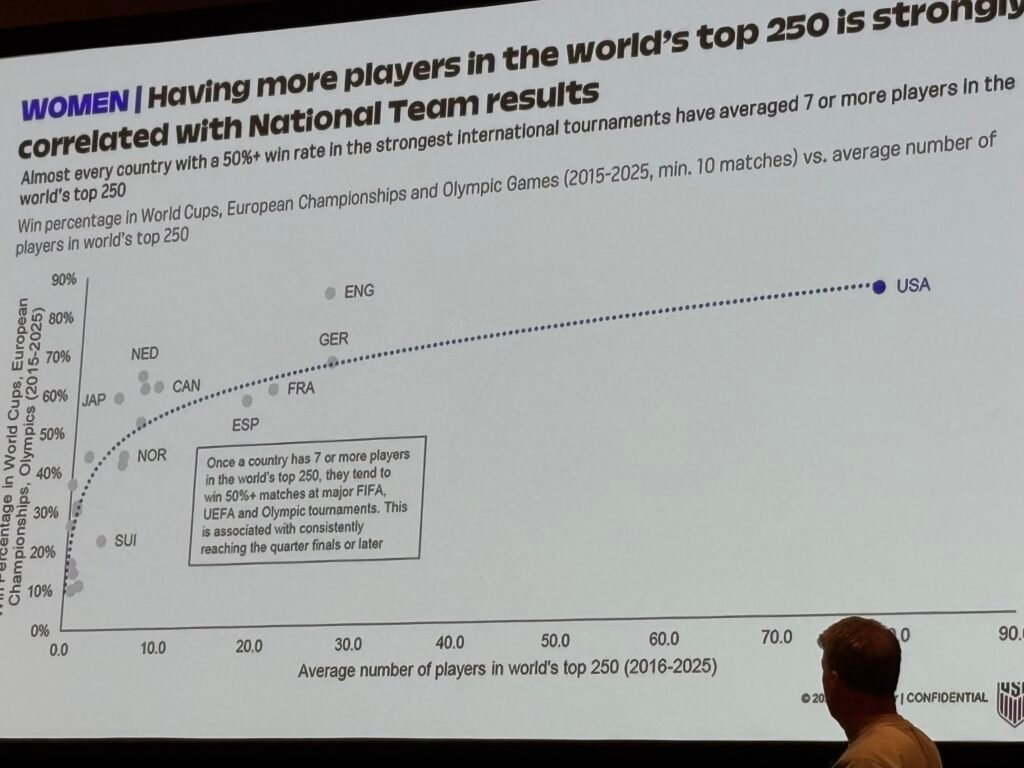
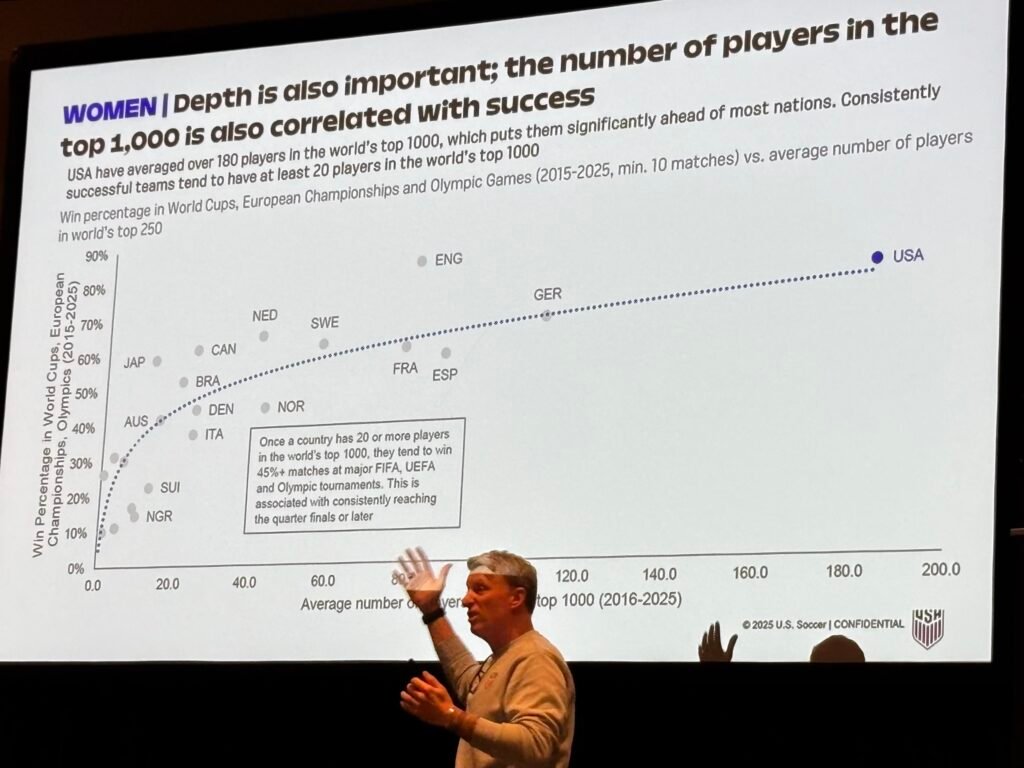
The data suggests that a country needs at least 4 players in the top 250 to win 50% or more of their games and compete for major trophies. The U.S. currently has one. Spain, the world leaders, average 33.8 players in top 250 over the past 10 years, followed by France (24.5), Brazil (23.5), and England (23.2). The U.S. average is .5 (essentially the same player). When a country has 15 or more players in the top 1,000, they tend to win more than 50% of their games and compete for trophies. The U.S. averages 5.8, which ranks 33rd in the world.


One of Crocker’s goals as Sporting Director is to align the national player pathway, something that at times resembles the Old West with multiple competing organizations and club structures from youth up to the pros.
“We want to work from a fragmentary landscape to working together,” he said.
At the youth level, there are multiple national champions, as different leagues and models compete over players, infrastructure, resources, and philosophies. As someone who’s been involved in the game for forty years, even I have trouble keeping up with the multi-faceted structure of soccer in the U.S. Imagine what it’s like for parents with limited soccer experience who have children entering the game at the grassroots level. Crocker pointed out to the money it costs players and families to bypass competitive teams in their own backyards in order to travel around the country just for games.Recently, U.S. Soccer announced a partnership with U.S. Club Soccer, a separate non-profit organization that in many ways competes against U.S. Youth Soccer, to provide backroom services and support in hopes of making soccer more affordable for the represented clubs and organizations.
Another point Crcoker touched on was the difference between a focus on winning and winning at all costs, which is drastically affecting the game at the youth level.
“I’ve got a son that’s moved over and been here for 12 months, and I’ve almost seen a little bit of that firsthand,” he said, “there’s so many kids at these showcase events, or whether it be tournaments, that walk off the field of play and towards their car, and their head’s down and they’re upset. Because I really do believe there’s such an emphasis and a focus on winning that the players feel an intense amount of pressure. And when they don’t win, when it goes wrong, they feel that is what they are judged on, rather than the coach having some clear individual objectives for the players that they work through in training.”
Crocker would like to see a change in the priority at the youth level.
“The ultimate result is something that the players can’t control,” he added. “But what you can hopefully help the players control is their individual performances.”
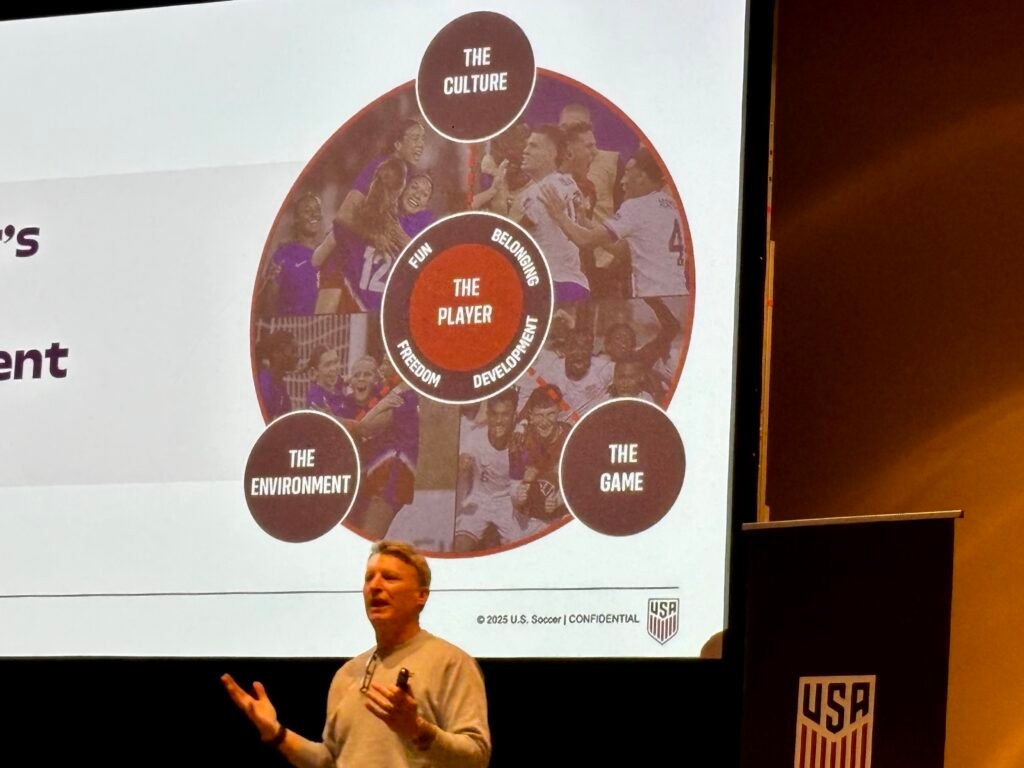
The U.S. Sporting Director advises that coaches and teams adopt a more player-centric model that can be used to foster individual player development over winning at all cost. Though he agrees that winning is an important part of player development, it can be the be all-end-all approach. Especially at the earliest levels. He proposes that coaches focus on the player’s individual’s needs first before anything, integrating the game and the culture and the environment to fit their needs.
“Can you spend more time really getting to understand the individual, which is the player that should sit at the heart of everything we do,” Crocker said. “Everything they do should be fun. Whether you’re working with world class players like Mauricio [Pochettino] or Emma [Hayes] at the top level sessions, they need to feel a sense of belonging, that they deserve to be there. And the best way of doing that is to reinforce it every single day.”
U.S. Soccer expects to release more data and initiatives in the near future with the goal of improving player development across all ability levels. But with less than six months away from hosting the world, it’s unlikely much will change on the men’s side in this vital World Cup season. They are multiple World Cups away from transitioning to frontrunners from group stage or bust. And with the women entering the next major cycle facing stiff competition from their European counterparts, a clear player development vision at the national level will hopefully boost the U.S.’s chances to remain a dominant force on the women’s side.