
A good offense starts with a good defense. That’s been a trademark of the Philadelphia Union for over a decade.
But where the defensive line begins can sometimes differ. Since Bradley Carnell began his tenure at the start of the 2025 season, fans saw an immediate change in the way the Philadelphia Union were going to attack the ball. Some phases of play carried over from the previous coaching staff, but the consistent aggressiveness from the front four players in Carnell’s 4-2-2-2 system was one of the separating qualities in the 2025 Union’s Supporters’ Shield-winning season.
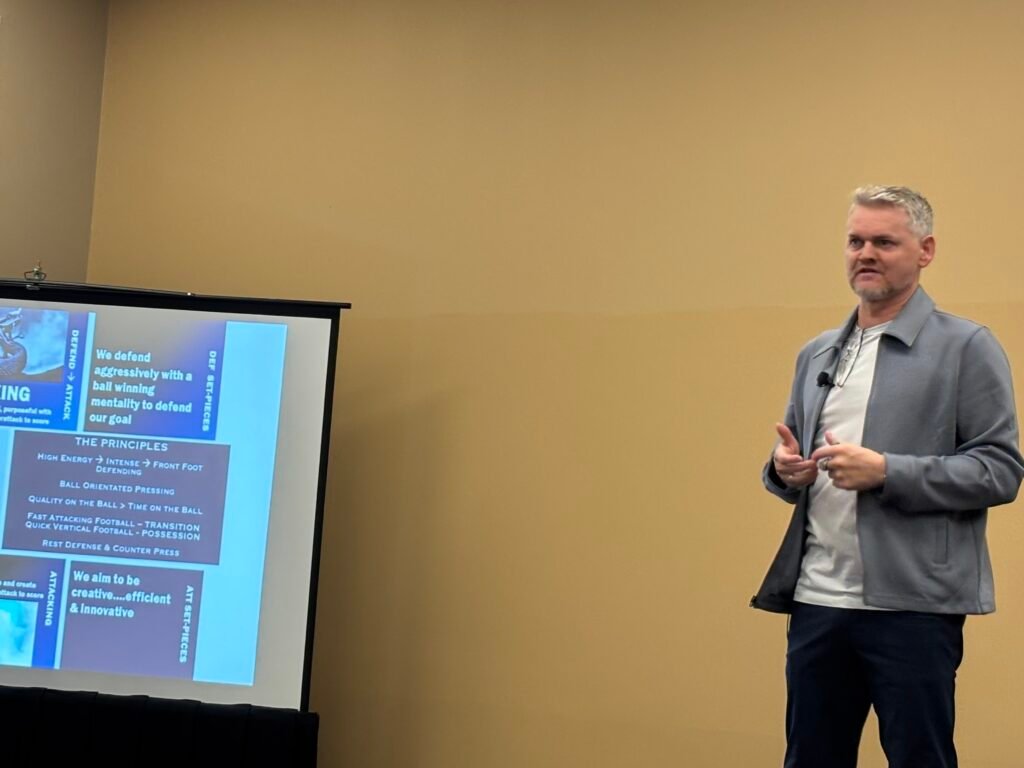
“Fast, energetic, proactive, on the front foot,” Carnell said when first describing his attacking mindset while addressing the packed room at the United Soccer Coaches Convention in Philadelphia last week. “I’m trying to win the game in the quickest way possible, so when we start talking about the game model in the transition phase of it, this is right up my alley.”
With strong influence by his former coach and mentor Ralph Rangnick, Carnell compared his attacking style to that of hunters, and one of his strongest principles has been building a team that can win the ball in the opponent’s end and strike quickly, ideally within 10 seconds. Much of his style of play comes down to a few key principles, but none as big as his team’s ability to counter and counter-press
Goals can come from many different situations on a soccer field, but Carnell has his team’s focus on a few. In his model, 60% of the goals should come from transitions, 30% from set pieces, and 10% from possession. In the 2025 season, the Union finished with a 50-30-20 ratio. And these numbers influence how his team prepares for each and every game, regardless of opponent.
“We track certain KPIs, and this is a real KPI, a key performance indicator, of how we do within our transitional game model. So transition shots this last year, within 10 seconds, we had 2.84 per game, which in MLS was second overall.”
Another stat Carnell tracks is what he calls pace to shoot, or how quickly the Union can get off a shot during those transitions. The Union’s 6.2 seconds was first in the league. Carnell also tracks the number of passes per shot sequence, which also measures how quickly the Union transition from a turnover to a shot. The Union finished with 2.3 passes per shot sequence, which he believes was even faster than Liverpool during their Champions league season a few years ago under Jurgen Klopp, who was also a coach under the Rangnick umbrella. Both of these stats ranked first in MLS in 2025.
“We have a turnover, a forward pass, vertical forward pass number two, vertical pass number three,” he said. “So within three passes, we’re getting a shot off.”
Much of Carnell’s presentation detailed how the Union attempt to win the ball and push it forward. Once they’ve established their high line of pressure, their first priority is to win the ball in their opponent’s end. Whenever they do win the ball, their next priority is to play as direct as possible. If they can’t play forward and fast, their next options are to switch the point of attack, though not with a long build-up or a beautifully clipped ball from outside back to opposite wide midfielder. His goal is to play through the forwards and utilize combinations to break a team’s backline as fast as possible. Then, if his team loses possession, they organize quickly to win the ball back before a retreat, something Carnell calls the security system. The offense to defense transition focuses on the team’s ability to recover and re-press, something the Union were very good at last season.
“I want to get a goal as quick as possible and dominate the game in the opponent’s end,” Carnell said, referring to the concept of field tilt, where his team impacts the game closer toward the opponent’s goal. The Union ranked twentieth in MLS in possession, but when it came to possession in the opponent’s half, they ranked fifth. “In terms of a transitional game model, to have that much control over the opponent and sustain that much, that’s the waves and waves of attack every time within our game model, and that’s where our attacking sequences start to happen.
A number of the clips Carnell used to highlight his team’s principles came in the 1-0 road win over FC Cincinnati on August 30th, which at the time was a battle for first in the Eastern Conference. In the tenth minute, the Union provide an example of multiple up-back-through combinations, leading to a shot from Quinn Sullivan that deflected off the crossbar. In the twenty-ninth minute, the Union execute a counter-press that resulted in Nathan Harriel picking out Tai Baribo at the near post. Though Baribo steered it wide, this was a classic field tilt example where the Union managed to maintain the pressure in Cincinnati’s end and turn it into a quick scoring chance. The Union’s goal in the forty-ninth minute came from a designed high press off a Cincinnati goal kick. The hosts tried to play out of the back, and the Union forced a mistake, attacked the middle with a combination, and got players in the box for a shot on goal, displaying many of Carnell’s principles in one game moment.
In several examples of his players executing the principles in training, Carnell showed how he designs intense game exercises three to four days out from a competition to replicate the transitional moments his players will experience in the game. Most coaches are familiar with the use of Rondos, which can be used for any number of game situations. But Carnell uses Rondos to emphasize his principles exactly on the field where the players will encounter the situations.
One example he showed begins on a full field with grids. The isolated Rondo began on a large square on the sideline just inside midfield where the defenders had to win the ball back then spring a counter by finding an outlet pass, turning the defenders in the Rondo into attackers going the other way towards goal. The actions simply repeat. Another Rondo Carnell used he called the 3 vs 2 to 7 vs 7 progression, where three attackers go at two defenders to goal, but when the play ends, the defenders join their five teammates on a separate 7 vs 7 field. The three attackers must perform a recovery sprint to help their four teammates at the other end. The transition becomes a 7 vs 7 game to goal that plays out for a specified amount to time until the exercise recycles.
During a Q and A period, Carnell outlined his training schedule leading up to games, with his game day minus three and four days having the highest volume, which is where most of his intense transitional exercises and games are played. On lower impact days, the team focuses on set pieces, the next biggest chunk of their training, with the possession principles intertwined among the transitional models.
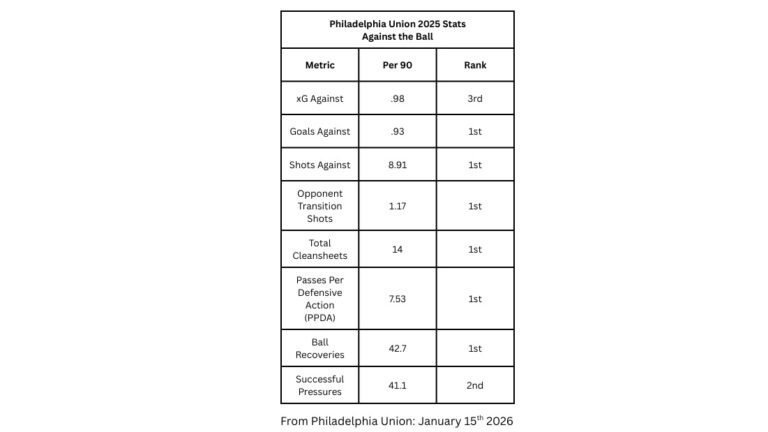
The Union have always been a stats-driven organization, and Carnell expressed the importance of his data points and the success his team had executing their game day models. Referencing the table below, the Union finished at the top or near the top in many of their priority defensive categories.
In the spectrum of coaching philosophies, where some coaches may prefer to possess the ball and break down opponents while others defend from the back forward, Bradley Carnell has always been deliberate in expressing his team’s desire to win the transitional game, turning defensive moments into attacking moments and vice versa. It’s this style of play that consistently transitions from the film room to the training ground to the game pitch that has kept the Philadelphia Union among the leaders in MLS. Defensive actions leading to rapid attacks will be the model going forward, and Carnell was gracious enough to share his mindset with his coaching colleagues, a treat when considering the amount of focused effort, cooperation, and data collection needed to turn a philosophy into a winning performance.