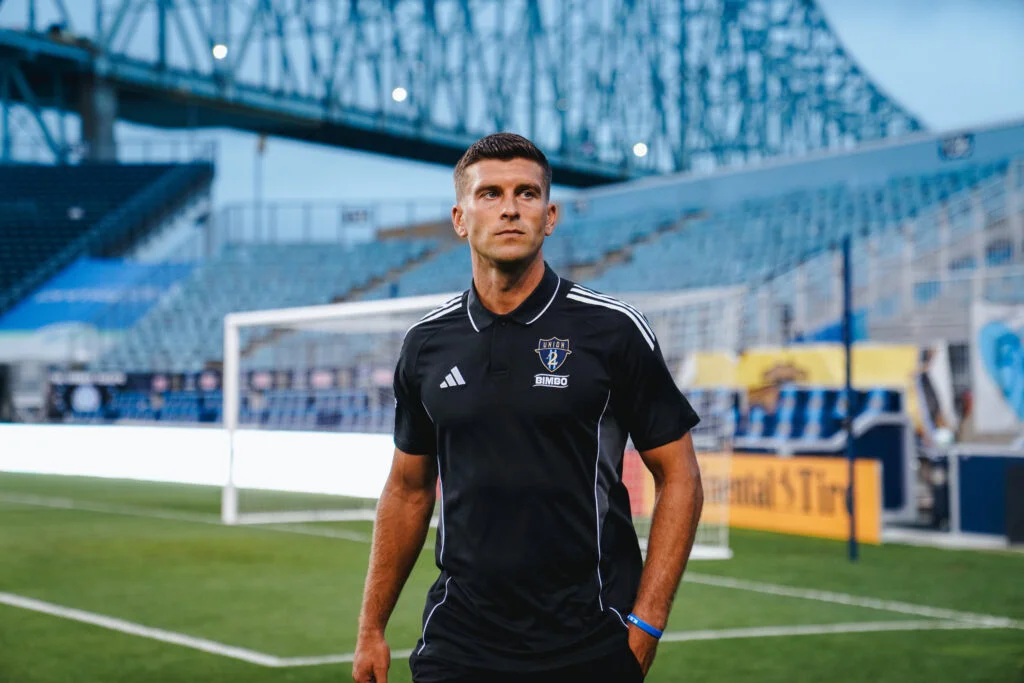
(Photo courtesy of Philadelphia Union)
In the fall of 2006, I was a member of the Council Rock South soccer coaching staff, mostly helping young players prepare for varsity time. During a varsity game against William Tennent, an athletic Tennent midfielder dominated the game from start to finish, delivering crunching tackles, winning challenges, setting up goals, scoring goals, all with a combination of skill, creativity, and grit. In a long line of Tennent soccer players who’d made it to the Division I level and beyond, this player was the best I’d seen. It was one of those moments as a young coach where I felt conflicted. I didn’t enjoy the buzzsaw of a midfielder taking apart my team, yet at the same time, I couldn’t help feeling prideful that someone so talented wore the jersey of my alma matter.
Almost twenty years later, Ryan Richter is now in his second season in charge of the Philadelphia Union 2, a team he once captained at the tail end of his lengthy professional career when they were known as Bethlehem Steel. Although Richter’s fitness level and competitiveness haven’t changed, his impact on local players has grown dramatically. Now leading one of the nation’s best teams at transitioning youth players to the next level, Richter is able to manage his playing and coaching experiences with one foot in the old and another firmly grounded in the new.
“The setup was a lot different then,” Richter said in an interview with Backyard Pitches. “High school soccer was a big piece of it.” Before the days of the academies, most developing players like Richter moved from high school to club to select to ODP programs throughout the calendar year, bouncing from teams, coaching staffs, philosophies, even sports. Representing the black and white on Tennent’s turf still meant something special. “It was a big honor,” he said about representing his school with his friends in front of his peers.
Richter played three sports in high school. In addition to basketball, his second passion though at one point his self-proclaimed number one, he also kicked for Tennent’s football team. His backyard pitches were at his home, spending all day training and playing, and on the basketball court at the Southampton Youth Center, which was near his home. He was an athlete by nature, so he’d have excelled in whatever path he chose, but soccer always had a place. “Soccer’s been in my family forever. My grandfather played, my dad played. It’s in our blood, and in our family culture.”
His soccer career started with Southampton, Warrington, and Phoenix, eventually playing for FC DELCO as he prepared for college. Though his journey looked a little different from the players he now coaches, he recognizes the tradeoffs between pursuing a professional career and trying to be a teenager.
“Now, the setup is probably better for development,” he acknowledged. “Look at some of the kids on my team. They’re in high school, and they’re way further than I was when I was at 17 or 18 years old. The setup now is definitely better for the development and better for the skill development, but as a person and what the game kind of meant, it was cool to be with your classmates and with the people you interact with every day. They know you as the soccer player. So that gave you confidence outside of school.”
At the Union, Richter oversees the tip of the Union Academy spear, which has a mixture of players who may already be earning minutes with the first team alongside players who may end up playing elsewhere, either with another pro club or in a college environment like the one he experienced as a four-year starter La Salle University.
“The kids that are at YSC, and the kids at Union 2, whether they’re signed players or academy players, they have the target of becoming a professional soccer player, this is definitely a better path that leads you to it.”
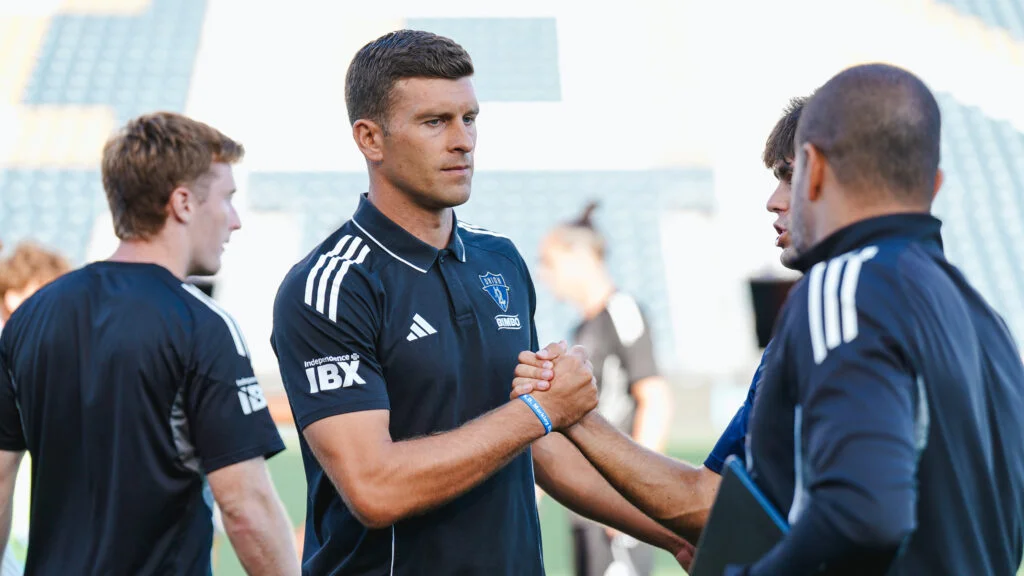
For decades, before the academy systems had been implemented in the U.S., the main youth soccer pathways went through the college game. But due to the restricted rules of the NCAA, the time to develop players and compete fell into two compacted windows, something a committee of coaches and athletic directors have been trying to change for years. The Union academy players now have an all-in-one training campus at the WSFS Bank Sportsplex that combines academics and soccer in one convenient place. The MLS academies also are able to operate on a year-round schedule and progress through an updated player pathway model that ends with MLS Next Pro, essentially generating a smoother transition toward reaching the first team than ever before.
At some point, when Richter was about the same age as the players he now coaches, he had the hint that his playing career would lead him to the pro ranks.
“I had a good freshman season, and that’s when I realized that could be something that is possible.”
He led the Explorers in his freshman season with five goals and four assists, earning A-10 All-Rookie honors. In the summer, Richter played for the Ocean City Barons (now Nor’ easters) in what was then the amateur-based PDL (now USL2). In 2009, Richter and the Barons won two rounds of the U.S. Open Cup before falling to D.C United. Richter went on to lead La Salle in both his junior and senior years, earning A-10 Offensive Player the Year his senior season as well as his second-straight Regional All-American award. When he left La Salle, Richter ranked sixth in goals (28) and seventh in points (69). He was inducted into La Salle’s Hall of Athletes in 2024.
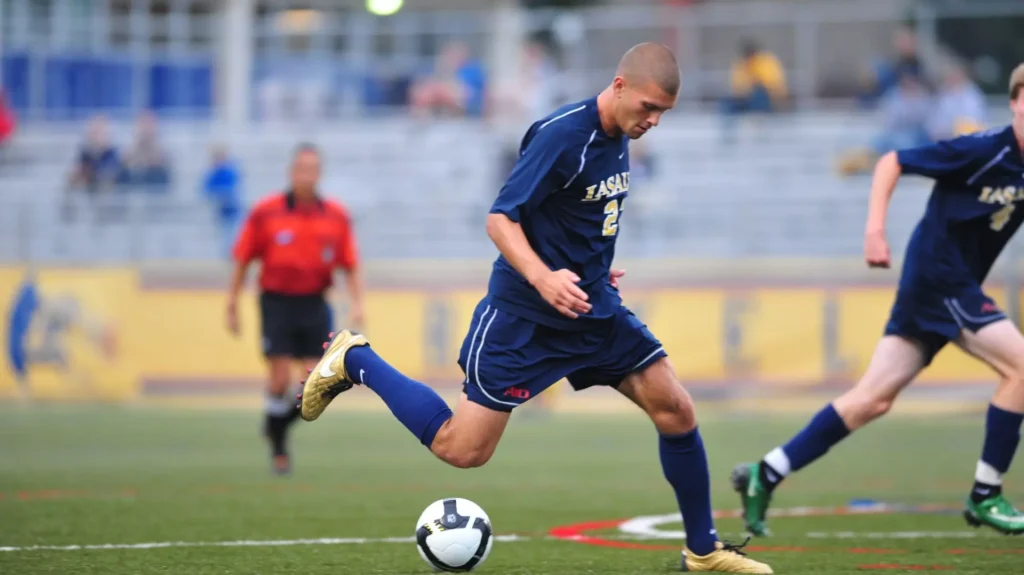
Selected by the Union in the 2011 Supplemental Draft, Richter trained with the Union, attempting to break into the first team under coach Petr Nowak. It was during this time he also began to explore his options off the field as well.
“While I was playing my first year, I was training in the offseason at YSC in Wayne, and that’s when I met Richie Graham and Ian Munro.” Graham founded the YSC Academy just before Richter joined the Union, so coaching youngsters became a natural side-hustle, which was often the case for players on the cusp. This led to opportunities coaching in the offseason as well as in the Union development programs. Munro has been a staff coach from the beginning.
“They asked me if I wanted to get involved in some of the youth stuff they had going on. I jumped on that right away. I love Ian Munro’s energy with the kids and how he can give me feedback, and I think he saw potential in me with my enthusiasm for the game. I realized then this was something I love also and I want to do that.”
After his first year with the Union, Richter moved on to Charleston in the USL Pro league and won the championship his first season at the club. His performances caught the attention of Toronto FC, and in 2013 he earned double-digit appearances in MLS. Eventually, his playing career took him to the Ottawa Fury and the New York Cosmos of the NASL before he returned to the Philly area with the Steel. He’s been involved with the Union academy ever since and progressed with the same work ethic he utilized as a player, developing his own philosophy and skillset.
“The best coaches I’ve worked with, they give you confidence, so I try to bring that every day to my players. And that doesn’t mean just being nicey-nice all the time, that means being honest. It means holding guys to a standard but also treating them as humans and understanding they go through tough moments too, and try to help them get through that so they can improve and feel good on the field.”
As a player, Richter had plenty of quality coaches to observe. His college coach, Pat Farrell, spent over forty-five years in the program and produced a number of pros including current Holy Family University coach Georg Montag, Cesidio Colasante, John McCarthy, and his son Joey Farrell, who recently retired after a near decades-long pro career. Richter’s coach at Ottawa, Marc Dos Santos, now leads LAFC. Gio Savarese, one of the original MLS stars, coached Richter at the New York Cosmos before he moved on to the Portland Timbers. As a member of the Union academy staff, Richter looked up to some of the older, more established coaches like Munro, Tommy Wilson, Phil Karn, and Kevin Coleman, the latter two also local stars like Richter. Karn, the former pro from Abington, has been with the Union academy for over a decade, and Coleman, a former Explorer, was one of Richter’s assistant coaches at La Salle before he joined FC DELCO and eventually the Union.
“I’m lucky to have a lot of great mentors and a lot of great coaches as a player but also a young coach.”
Finding his center while with the Union has been a rewarding experience. “The people I work with are so passionate about this. There’s nothing better than being on the field, whether it’s as a coach or player, there’s no better place for me.”
Ahead of the 2022 season, Union coach Jim Curtin added Richter to his senior staff following the departure of Pat Noonan to FC Cincinnati. Thrust into a team on the verge of MLS glory, Richter became Curtin’s right-hand man as they led the club to the brink of an MLS Cup, only to be outdone in the final by Richter’s former La Salle teammate McCarthy and LAFC.
“Jim had great qualities in the way he managed the group,” Richter said. “Never getting too high, never getting too low. It was really cool to see, keeping the players in the right headspace to perform.” As one of the few holdovers when the Union hired Bradley Carnell late in 2024, Richter continued to soak up knowledge from Carnell, who implements some of the same principles of play but with different priorities. “His professionalism and his detail are incredible,” Richter said about Carnell.
“You take pieces from both of them to see what you like and try to be the best version of you.”
As the head of Union 2, Richter’s coaching roles have changed somewhat. “As an assistant, you’re doing everything you can to help the head coach. You’re preparing for games, preparing the players, running training, but you’re not really making the decisions.” Now he’s also planning game strategy, making playing decisions, evaluating players, creating relationships, and responding to the litany of daily tasks of running a team. “That’s a big piece of why I love this job with Union 2 because as I want to progress in my career, these are the things you have to get better at. You have a million decisions to make every day, and it’s about trying to get as many right as you possibly can.
Union 2 opened the season with wins over Toronto FC II and FC Cincinnati 2. Toronto’s second team coach, Gianni Cimini, played for Philadelphia University in the mid-2000s, while Philadelphian and FC DELCO alum Sammy Castellanos took over as coach of FC Cincinnati 2 at the start of the season. Last week, the Union 2 fell to CT United, one of a handful of growing professional organizations operating independently from MLS clubs. But the new season brings some new players with varying degrees of development plans, which is something Richter will be tasked with managing throughout the season.
“We’re going to have different challenges this year because of the players we’re responsible for,” he said. Last season, Richter coached a core group of players who had been with Union 2 for at least a year, and the goal was more to progress them into the first team. “This year we’re kind of at the beginning of the phase, where not a lot of the guys have had a ton of experience at this level, though it’s about getting them up to speed and seeing how far they can push through this season.”
Last season, Cavan Sullivan played mostly with the Union 2 and floated with the senior team, but he’s now headed towards a more prominent role. Sullivan scored his first two goals against Defense Force FC in the Concacaf Champions Cup, setting up two more to earn Player of the Match and Team of the Week honors. 2025 U2 leading scorer Stas Korzeniowski was one of Richter’s more senior players, signing after his standout collegiate career at Penn. He’s had some significant minutes at the start of the season as well and also scored his first two goals in the 7-0 win over Defense Force FC.
Frankie Westfield and Andrew Rick, who were regulars in the Union 2 XI the past few years, have become important pieces for the first team. Westfield started a majority of the games since the beginning of last season and represented the U.S. at the 2025 Under-20 World Cup, leading the U.S. to the quarterfinals where they lost to eventual champion Morocco. Rick has had his healthy share of starts while Andre Blake battled injuries and departed for various international duties.
Some of Richter’s other former players, Neil Pierre (Lyngby), C.J Olney (Brooklyn FC), Markus Anderson (Brooklyn FC), have been loaned out this season to earn more regular minutes, while goalkeeper Mike Sheridan now plays with the Pittsburgh Riverhounds. The Union traded U.S. youth international David Vasquez to San Diego midway through the season last year, and he’s had a remarkable start to 2026, scoring in his Concacaf Champions Cup debut in a 4-1 win over UNAM Pumas before scoring twice, including the winner, in a 3-2 win over Toluca in the first leg of the Round of 16. Early in the season, two current Union 2 starters, Giovanny Sequera and Sal Olivas, made appearances for the Union in Concacaf and MLS competition.
This year, Richter’s core includes Malik Jakupovic, Kellen LeBlanc, and Rafael Uzcátegui, among others, who bring a wealth of youth international experience but are now thrust into a bigger spotlight. Richter’s 2025 team earned the most points in the Eastern Conference (58) yet finished second behind the NY Red Bulls II, who knocked them out of the MLS Next Pro playoffs 2-1 in the conference finals. The 2025 team set new records for wins (15), goals scored (64), goals against (34), and goal differential (+34).
It's just what he does 🤷
— Philadelphia Union II (@PhilaUnionII) February 10, 2026
EIGHT goals in just three matches for Malik! https://t.co/emuaUtuqnB
“It’s a different dynamic this year,” Richter said. “Last year it was a lot of managing the motivation, guys were maybe training with the first team but not getting first team minutes, and it was more about managing the motivation and their attitude they need to approach the Union 2 games and the Union 2 training. This year, it’s really about improvement, getting that you can be a performer at the level of Union 2.”
And if anyone was wondering if the winning expectations change due to the younger age of the squad, Richter has a simple answer. “For me, it doesn’t because one I’m a competitive person.”
Richter expanded on the intention of winning in player development. “We talk about development, but what does that mean? The coach in the first team wants players who will help the team win. What kind of players would we be developing, what kind of sportsmen would we be developing if we said we don’t care about the result? That’s not the way this business works. So we have to have them with the right attitude, the right mindset that they’re willing to do anything for the group. Perform well as an individual but willing to do anything for the group to achieve the team goal, which is winning the game.”
Richter’s been involved in the game since he was a youth player, even though his soccer roots go back even further. Since 2018, he’s been involved with his hometown club, imparting his wisdom on young players who will go on to represent the area and the region the same way he did. And to him, the motivation hasn’t changed.
“I love being on the grass, the training every day, I love that. But it’s really fun to see these young men chase their professional dreams and to try to help them any way that we can to achieve that.”