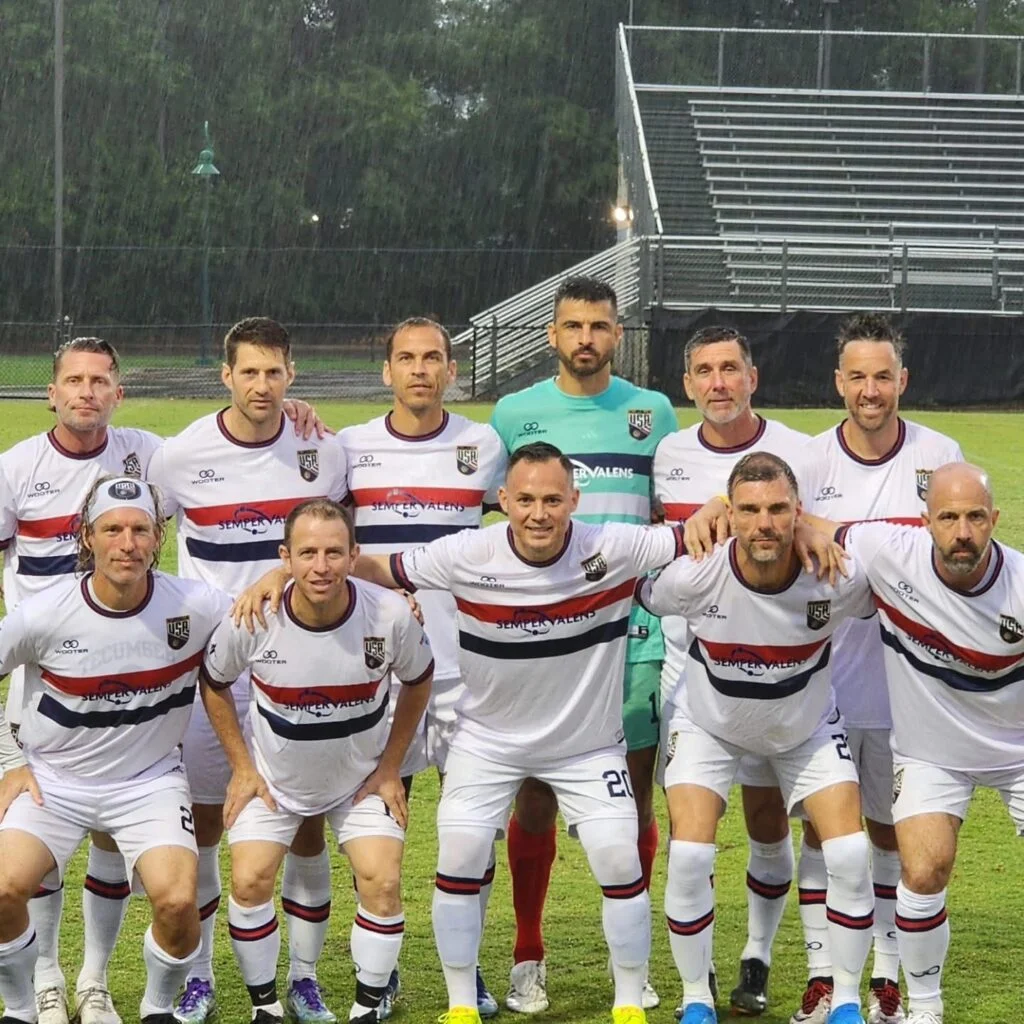

Photo courtesy of Nut Shutter Sports
Jack Pocorobba’s journey to the Senior Men’s World Cup started long before he even knew it existed. For much of his life, his goal was simply playing the game he loved at the highest level possible for as long as he could. It wasn’t until a year ago that the reality of representing his country materialized. Now, at age 43, Pocorobba, a Council Rock graduate and senior corporate executive, is playing for the United States in the Senior Men’s World Cup in Thailand.
“It’s a culmination more than anything,” he told Backyard Pitches in an exclusive interview prior to his departure for Southeast Asia, “never stopping to play and always finding space for the game.”
Pocorobba said a combination of the fitness benefits, camaraderie with teammates, and the development of long-term friendships, even with opponents who eventually became friends, were all evidence that he was always on the right track. “When you sit back and think,” he said, “it’s not for nothing.”
For most soccer players, the ability to find time for the game over the course of a lifetime can become more difficult with age. Players at the grassroots levels through teenage years have the schedule to eat, sleep, and play soccer. It’s much different when players have jobs, family commitments, and require more mental and physical recovery. For Pocorobba, finding a partner who shares his passion and supports his efforts was essential. He jokes that when he met his now wife Lindsay, allowing time for soccer Sundays was part of the package.
“It’s the single, most important component of our relationship relative to this,” he said. “Her understanding of competitive sports, and the drive, never changed.” Lindsay and their two kids, Jack and Lily, along with their parents, drove to South Carolina for the pre-tournament camp where the U.S. played several friendlies against local NPSL teams prior to the final roster announcement.
“I only played thirty minutes at a clip in each game, because that’s all everyone’s going to play to manage minutes, and they were there. They didn’t leave. To say it meant everything is an understatement.”
The emotion of playing for his country as he was about to embark on a flight around the world inspired much of his gratitude, and a lot of his appreciation was directed toward a partner comfortable adjusting to his sometimes unbalanced life.
“You can’t get this opportunity without a wife, who when you’ve traveled Monday through Thursday for a big corporate meeting, then come home Thursday for an indoor game. But you can’t be here if you don’t do that either, so I feel somewhat indebted to her for this experience.”
What makes Pocorobba’s path to an elite competition so special is the length of focus over decades that has allowed him to continue to grow and thrive in a game that so many consider to be a youthful experience with a running shelf life. While today’s players may be thrust into competitive environments at an early age with the end result being a college scholarship or pro contract, Pocorobba refers to his own career, as well as comparisons to player development in other countries, where soccer is considered a lifetime physical activity. His compounding skill and knowledge has come from consistency and longevity. Not from what team he played for a youth.
As a coach, he sees firsthand how the push for early success has impacted the larger picture, something he struggles with often. “There’s no replacement for playing the game,” he said. “By not stopping, you inevitably improve. In addition to the intensity at which you play.”
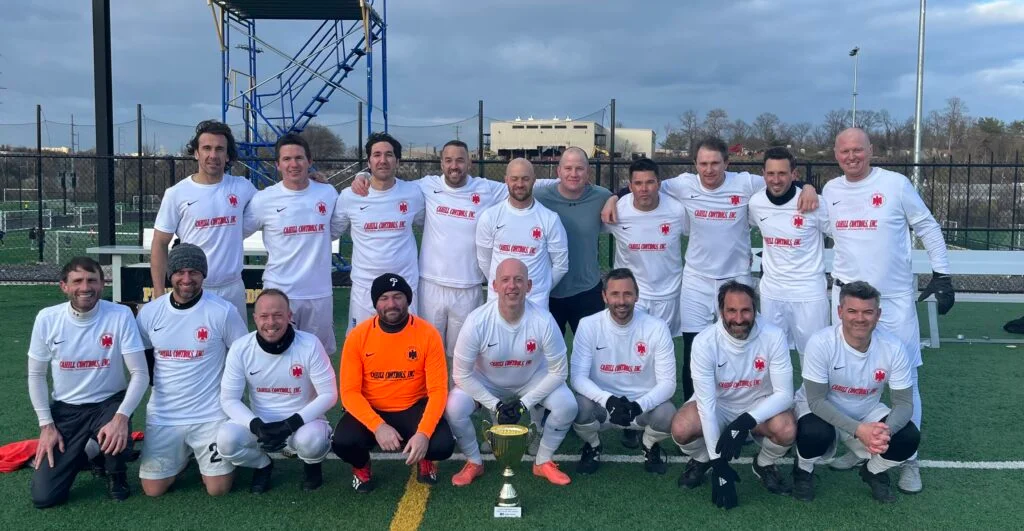
For much of his adult career, Pocorobba has been a member of Phoenix SC, also known as the First German Sport Club. Located in Feasterville, Phoenix is the oldest remaining club in the Philadelphia area, founded in 1926. Carrying a long tradition of soccer among the German leagues, ASL, and USL, Phoenix enjoyed a period of growth and success from the early 2000s, capturing numerous state championships (2003, 2007, 2009-11), and advancing deep in several regional competitions in both the Open and Amateur cups throughout the decade. Phoenix qualified for the Lamar Hunt U.S. Open Cup in 2011 after reaching the Region 1 final. The same core group of players eventually claimed the Gerhard Mengel Over-30 National Cup in 2016.
“There’s a benefit to being at a club and not just play,” Pocorobba said, “but after you’re done, sit with the guys and talk about the game, and talking about what went well, then over time, play with some really great players. All that organic conversation has inevitably helped me become a better player.
He credits his time at Phoenix for his growth both on and off the field.
“Not only was it this space for me to individually separate from the chaos of my professional life, and the stress of life, to play a game I love, but it was a world, and a world still, that understands me and believes in me. It’s so hard to explain to people outside of our area that haven’t played in it.”
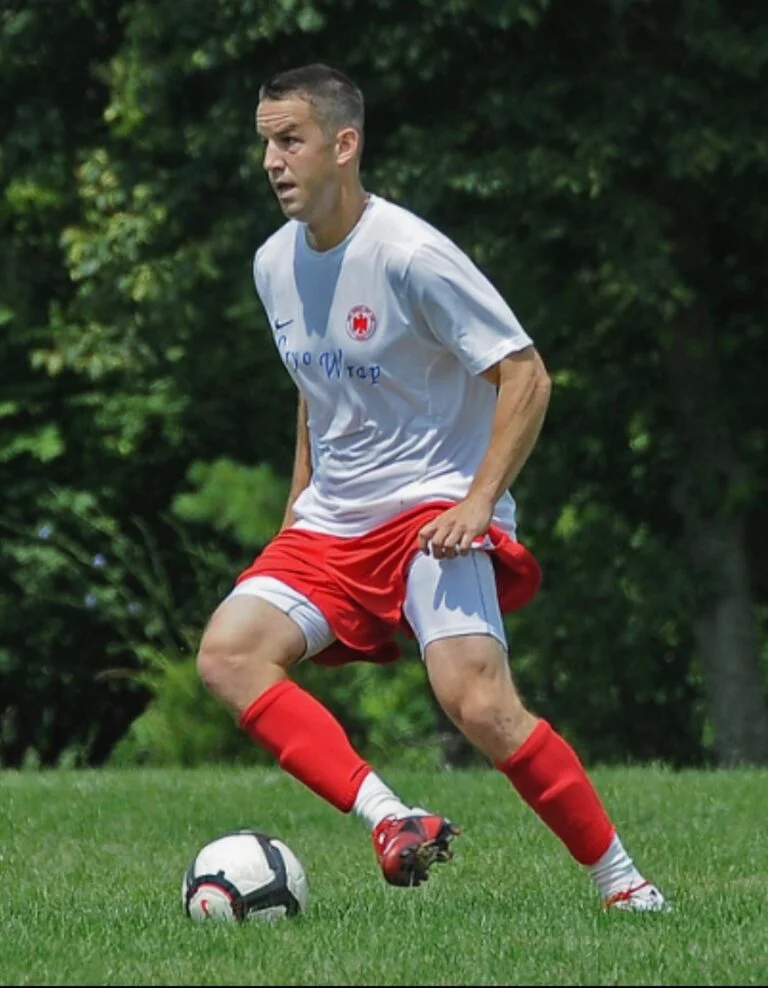
Success didn’t come easy for Pocorobba, and in the early days of his career, he noted he wasn’t the player who stood out the most.
“I grew up never being on the best teams,” he said, adding that his Council Rock teams failed to live up to the school’s reputation for competing for district championships throughout the 1990s when led by school legends like Gus Zangrilli and Bobby Francis, who later became his Phoenix teammate. “We weren’t good. I was mediocre. I got recruited to Kutztown. I got cut my first year.”
Whereas most people may be inclined to hang up the boots after experiencing the failure of not making their college team, especially with allure of school life, Pocorobba continued to fight and take his game to a higher level. Back then, it wasn’t Phoenix but another local powerhouse, United German Hunagrians, fresh off a near amateur-open cup double in 1999, who took him in.
“One of the things that pulled me out of this black space after I got cut was a teammate of mine, Steve Blank, driving me and another kid that cut, to UGH every Tuesday and Thursday night in the fall to play with the reserves. We played with the reserves, we’d hang out, we’d go to his uncle’s house, [Andy] Weyershaeuser’s house, then we’d go back to Kutztown. The world that was these clubs in the area saved me from quitting to some extent. Once I got my head on straight, there was a chip on my shoulder, and a drive, not to prove to the person who cut me, but to prove to myself that I could do more and could be better.”
After finding his footing in the game, Pocorobba spent the next three seasons playing for the Golden Bears before finishing his collegiate career at Arcadia. He’s been a part of the Phoenix program ever since and described his early years with Phoenix as a sponge, learning from talented local players like Steve Mellor, Ben Castor, Francis, Ryan Kelly, and Danny Murtagh, among others whom he felt compelled to join on the field.
“Those environments and those chances to step up and prove yourself, like what I’m about to do, you can’t replace that as a competitor. The challenges can be everywhere.”
As a Phoenix player, he worked his way up from a role to player to a starting right back, eventually moving up toward a central midfielder, where he’s spent a majority of his career since. For over a decade, he played for Blair Thompson, the longtime coach of the majors and a pillar in the USLPA.
“If not for Blair Thompson, he was the original glue that engaged the guys and had us all to want to be there, that came from all these different places, I owe so much to him. He was the first person to say to me, pass the ball to the nearest person. The game will be so much easier. He always gave me a chance to play at levels that were new to me.”
Now, with the Over-40s, under the guidance of player-manager Greg Mangles, Pocorobba and Phoenix continue to play with their sights on a return to the national championships. This spring, they lost their regional opener to Central Park Rangers Old Boys, who will meet Safira in the finals at the Ukranian Nationals club this weekend.
Pocorobba’s invitation to the U.S. Camp came from a lengthy ID process that began years ago while head coach Dave Jones scouted players from the regional competitions. At training camp, Jones whittled the pool of 33 players down to 25, and the team departed from Carolina late last week on a twenty-five hour flight to Bangkok. The Senior World Cup has different rules for the specific age ranges, which makes strategy more unique. Over-50 players have unlimited substitutions while players under 44, like Pocorobba, have no re-entry. The team must have at least four players aged 45-49 and three each from 40-44 and over-50 on the field at all times.
“It’s a good team,” Pocorobba said, noting that as a collective they’d easily compete for a national Over-40 title. “We haven’t played together a ton, even in camp, so that’ll be the thing. We’ll see if we can come together and understand each other, but there’s so many good players here.”
Some of his teammates include Thomas Greenawalt (Philadelphia, PA), Matt Lucas (Cape May, NJ), Jimmy Connor (Vineland, NJ), and Mike Lodge (Malaga, NJ), whom he’s bonded with since the start of training camp. His new teammates even include a small group who play for Christos FC, Phoenix’s regional rival and the cause of a number of tough Phoenix losses over the years.
The U.S. opened the tournament Monday with a 2-0 win over Taiwan on goals scored by Ryan Miles (Nashville, Tennessee) and Tim Blodgett (Sanford, North Carolina). Pocorobba came on in the 52nd minute as central midfielder and controlled the steady pace. This morning, the U.S. defeated Thailand 1-0. Jeremy Moore (St. Louis, Missouri) scored the lone goal, and Pocorobba started and played the first half. With a grueling schedule over the course of the week, the team will need to recover quickly as they face England, led by longtime Premier League player Garreth Barry on Wednesday, June 3rd to decide the top of the group. The game will kick off at 6:00 a.m. and be streamed live on Amigo Sports. The semifinals will take place Friday, June 5th with the final on Saturday, June 6th.